|


 |


|
 |
 |


 |
| Design Architect |
Mario Bellini |
| Production Architect |
Yukitaka Kawazu |
| Lighting Planner |
Kaoru Mende |
| Sign Planner |
Tetuichi Tomonaga |
| Construction |
Obayashi Co. |
|
 |
| Completion |
December, 1991 |
| Floorspace |
11,874m²(11 floors) |
| Building Structure |
SRC |
| Parking Spaces |
42 |
|


 |
 |
Mario Bellini Profile

Mario Bellini, the architect was born in Milan in 1935, and today is one of the most important architects and industrial designers in the world. He is best known in Japan through his best-selling furniture. He has visited Japan more than 30 times in the last 20 years and has designed this Center with a deep understanding of Japan's cultural and marketing background. |


From Mario Bellini 1991.12

When I was taken to the spot, I was immediately attracted by the immense difficulties of the task: to design what was to be the Tokyo Design Center on an area that was both important and extremely difficult. Facing a very wide avenue, the Sakurada Dori, and visible every day by millions of people from the nearby platform of Gotanda Station, the site is a remarkably irregular one. It is partially obstructed by an existing commonplace building which interrupts the site's continuity, whilst on the side behind the street, it is confined, up to third-floor level, by a surprising Japanese garden that climbs steeply.
I quickly felt that the central theme of the architectural composition was to give unity, Identity and depth to the whole building while taking advantage of the unusually divided street front and of the differences in height and landscape. Two wings, almost two towers, squeeze the extraneous building between them until it actually "disappears" as a result of their clear and sharply recognizable design.
A public galleria crosses the new building diagonally, thereby also visually connecting the station and the urban level with the Internal raised garden.
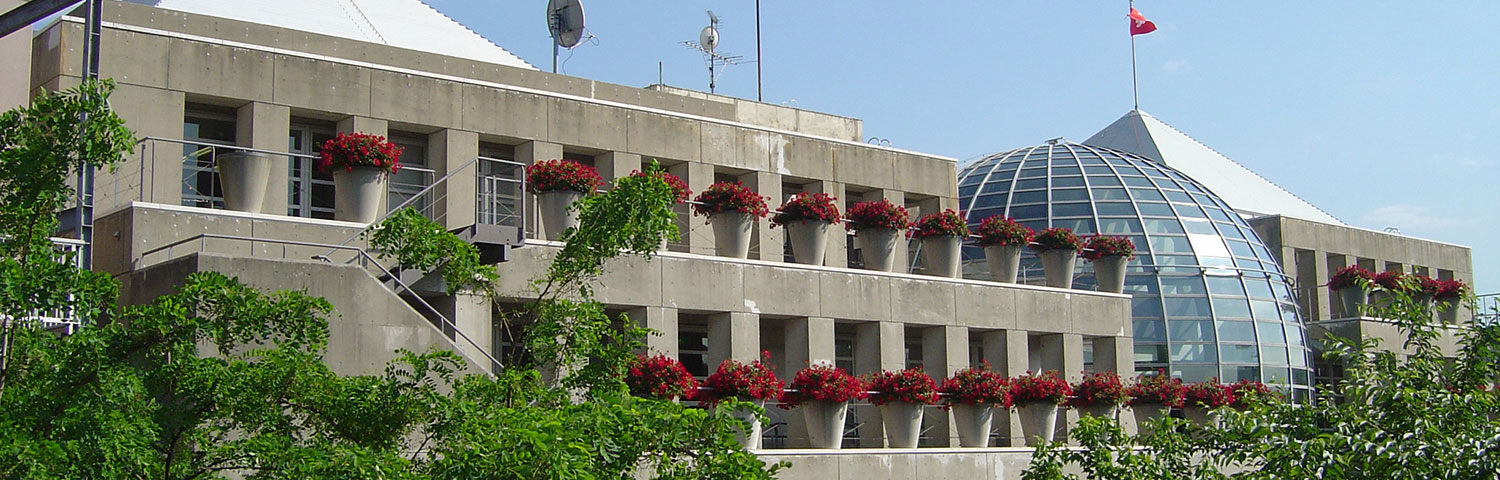
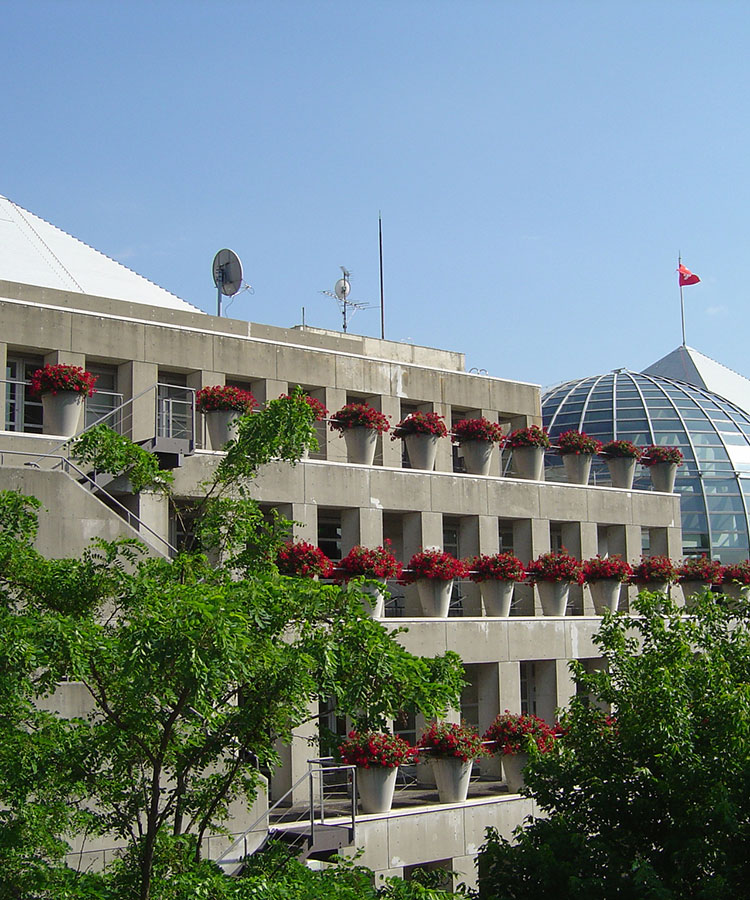
The galleria distributes and interconnects all the access points and most significant parts of the Design Center, stressing its role, form and position like a gigantic X-ray. Among these the most Important, due to its function as a continuous vertical pivot, is the cylindrical and glazed elevator hall. This cylinder surfaces and emerges in the shape of a cupola from the solid terraces stepping downwards which, with their rhythmic rows of terracotta vases, respond to the old Japanese garden as an emblematic garden-building in the Italian style. |


 |
 |

 |
 |
 |
The facade on Sakurada Dori side

The facade on Sakurada Dori (main street) side is exposed concrete with Travertine marble grids, with the main entrance galleria rising five stories and going through the building to the garden in the back. |


 |
 |
The galleria

The galleria covering five floors leads to the green garden courtyard. |


 |
 |
The elevator hall

The elevator hall is encased in a cylindrical glass tube under a dome, and accomodates three elevators. |


 |
 |
Facing the garden slope, the facade on the garden side

Facing the garden slope, the facade on the garden side shows the glass-domed elevator hall,the galleria through to the main street, with terraces adorned with potted greenery and the colonnades facing the showrooms. |
|


 |
 |

 |
We are at the start of a new century. The pace of change is already accelerating. Countries seem to be less far apart. Their different cultures have become intermingled, and a new kind of lifestyle, different from anything in the past, has begun to emerge.
This new era demands new designs. The industrial revolution, the age of the consumer society and the machine - it is during periods such as these that new languages of design have come to the fore. Design is international by nature and its development is synchronized throughout much of the world.
Tokyo - a city on the edge of Asia, is increasingly an international metropolis. It was here that, in the spring of 1992, the first full - scale complex of interior design showrooms of its kinds in Japan, came into being - the TOKYO DESIGN CENTER.
It functions as a meeting place for designers, manufacturers and users to enable people to incorporate design into their own lives as fully as possible. Here they can select the finest in contract and residential furniture, carpets, floor coverings, fabrics, wall coverings, lighting and accessories from Europe, America and Asia.
Because it brings together in a single location showrooms displaying prestigious brands of interior design, the Tokyo Design Center is proving popular not only among professionals such as architects and designers, but also, more widely, among the general public.
A significant feature of the Center is that it is the work of the renowned Italian designer and architect, Mario Bellini. In this, the first building that he has designed in Japan, Mario Bellini has managed to create a unique form, which turns to advantage the divided street front and the complex contours of the site. An entrance passage and staircase cut through the new building diagonally, connecting the urban bustle of Gotanda with the peace of the raised garden behind. The cylindrical, glazed elevator hall unites and unifies the whole structure and emerges in the shape of a cupola overlooking the six rhythmically sloping terraces at the back of the building. These, with their rows of rose-filled vases, evoke the architecture of Italy while harmonizing with the old Japanese garden, which slopes down from the rear towards them.
Another distinctive feature of the building is its exhibition hall, the GALLERIA. The first event to be held here was a retrospective exhibition of Mario Bellini's own work. Since then the Tokyo Design Center has staged many cultural events. These have included a series of exhibitions showing the high standard of Japanese photography; a project to provide young visual artists with space in which to exhibit their latest work; and a number of symposia which have taken as their theme the relationship between art, design and space in contemporary life. the aim of the Center is to provide a place where fields of design besides architecture and interior decor can also develop. |


|
 |
 |
 |

|
 |